

Ask ten people what a multi-vendor marketplace is, and nine will tell you it’s ‘like Amazon.’
That’s not wrong. But it’s not useful.
Most definitions describe a marketplace from the outside, what buyers see when they shop on it. Nobody writes about what it actually means to build one, run one, and make money from one. That’s the definition that matters if you’re the operator.
I’ve spent the last few years working alongside the team behind Dokan – the Multi-vendor WordPress plugin powering 40,000+ active marketplaces worldwide. I’ve seen what operators get wrong before they launch, and what the successful ones understood from day one.
This is the definition they wish they’d had.
What Every Other Definition Gets Wrong
Here’s the problem with most ‘what is a marketplace’ articles.
They define a marketplace the way a customer would – ‘a place where you can buy from multiple sellers.’ That’s accurate. But it tells an operator nothing about what they’re actually building.
It skips the questions that actually matter:
- How does money flow from a buyer to three different vendors in one checkout?
- Who is responsible for calculating and remitting sales tax across multiple sellers?
- How does the platform operator earn revenue without selling anything themselves?
- What happens when a vendor goes rogue and starts selling counterfeits?
None of that appears in the standard definitions. Here’s the version that does.
What Is a Multi-Vendor Marketplace?
A multi-vendor marketplace is an ecommerce platform where multiple independent sellers list and sell their products or services, while a single operator manages the platform, controls the buyer experience, and earns revenue through commissions, subscription fees, or listing charges – without holding inventory or fulfilling orders directly.
Here’s the thing: that’s a fundamentally different business model from running an online store. And it requires a fundamentally different platform to power it.
Multi-Vendor Marketplace Definition
A multi-vendor marketplace is a platform with three roles: the operator who builds and runs it, the vendors who sell on it, and the buyers who purchase from it. The operator earns a cut of every transaction. The vendors keep the rest.
Think of it as building a shopping mall, not a shop.
The mall owner doesn’t sell anything. They rent space to shops, maintain the building, set the rules, and take a percentage of every shop’s revenue. That’s exactly how a multi-vendor marketplace works — just online, with vendors instead of shops, and software instead of a building.
The Key Difference: Marketplace Operator vs Marketplace Vendor
This distinction trips up more new marketplace builders than anything else.
| Marketplace Operator | Marketplace Vendor |
| Builds and manages the platform | Lists and sells products on the platform |
| Sets the rules, commissions, and policies | Follows the operator’s rules |
| Earns revenue from commissions and subscriptions | Earns revenue from product sales (minus commission) |
| Never holds inventory | Manages their own inventory and fulfillment |
| Responsible for platform trust and compliance | Responsible for product quality and order fulfillment |
| That’s you – the FlyCommerce user | That’s your sellers |
FlyCommerce is built for the operator. Every feature — vendor onboarding, commission management, role-based access control, tax automation — exists to help you run the platform, not to help vendors sell their products.
How Does a Multi-Vendor Marketplace Work?
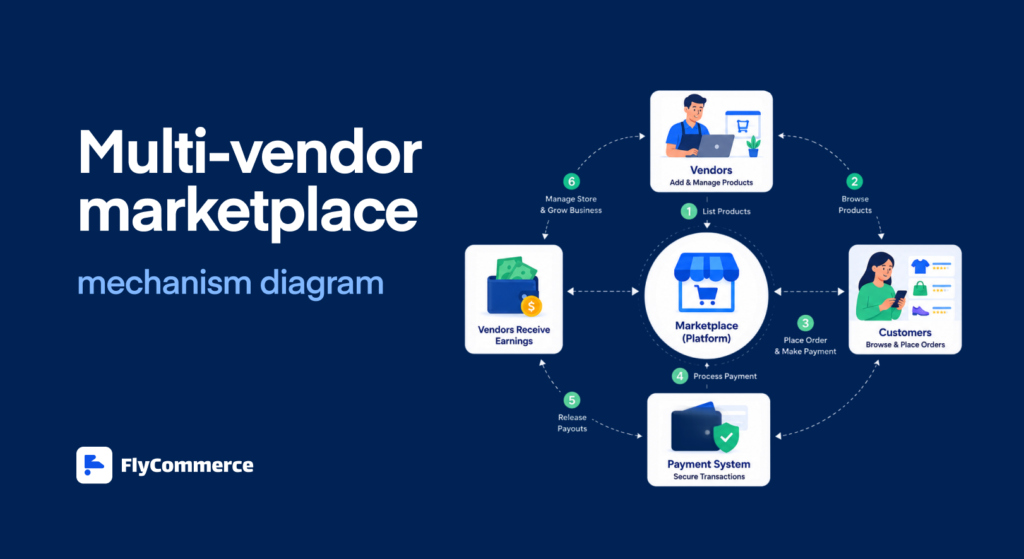
Understanding the mechanism is what separates operators who launch confidently from operators who launch confused. Here’s the full flow – from the moment a vendor joins to the moment money lands in their account.
Step 1: The Vendor Lists Their Products
A vendor applies to join your marketplace. You review their application and approve or reject it — your rules, your standards.
Once approved, they get access to their vendor dashboard. From there, they add their products: photos, descriptions, pricing, inventory count, shipping options. All of it managed by the vendor. None of it managed by you.
On FlyCommerce, vendors can bulk-upload product catalogs and manage orders from a single dashboard. You set how much control they have and how much you keep.
Step 2: The Buyer Discovers and Purchases
A buyer lands on your marketplace storefront. They browse products from multiple vendors — but they see one unified shopping experience. Your branding. Your design. Your trust.
They add three products from three different vendors to one cart. They check out once. One payment. One confirmation email.
The buyer has no idea they just bought from three separate sellers. That’s by design. The marketplace experience is seamless. The complexity of splitting that payment across vendors happens entirely behind the scenes.
Now: the part most people miss.
Step 3: The Platform Splits Payments and Pays Vendors
This is where marketplace operations get complicated — and where most self-built platforms fail.
The moment a buyer pays, your platform needs to:
- Calculate the commission owed to you (for example, 15% of the sale price)
- Calculate and withhold the correct sales tax for each item, in each jurisdiction
- Queue a payout to each vendor for their share of the transaction
- Generate transaction records for accounting and compliance
On FlyCommerce, this happens automatically. Tax is calculated in real time via Avalara AvaTax. FlyCommerce is the only multi-vendor marketplace SaaS platform with both Avalara AvaTax certifications: Sales Tax Calculation and Document Management (ECM) for B2B exemption certificates.
Vendors get paid. You keep your commission. Tax is handled. No manual reconciliation.
Step 4: The Operator Earns Revenue and Manages the Platform
Here’s your business model as a marketplace operator.
Every transaction generates commission revenue. A 15% commission on a $100 sale means $15 in your pocket – without buying, storing, or shipping anything. Scale that across 50 vendors doing $10,000 each per month, and you’re looking at $75,000 in monthly revenue from a platform you built once.
Beyond commissions, you can charge vendors a monthly subscription fee to list on your marketplace. FlyCommerce supports tiered vendor subscription plans — free, basic, pro — each with different product limits, commission rates, and dashboard features.
The result? Two revenue streams. One platform. Zero inventory risk.
| → Want the full guide? Learn how to build a multi-vendor marketplace step by step — platform choice, vendor setup, payment configuration, and launch. |
Multi-Vendor Marketplace vs a Regular Online Store: What’s the Difference?
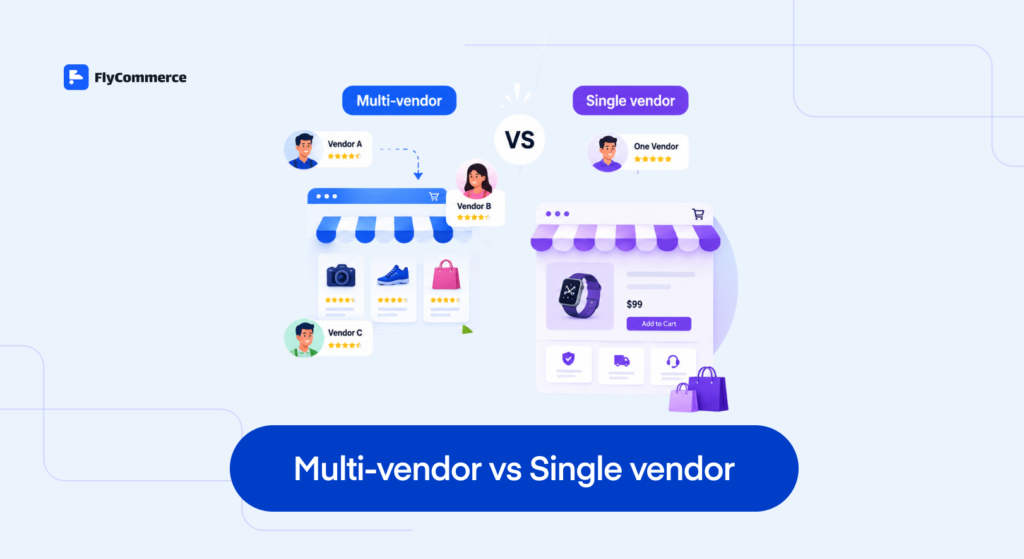
The core difference is this: an online store has one seller. A multi-vendor marketplace has many.
But that single difference changes everything — the platform architecture, the revenue model, the operational complexity, and the growth ceiling.
| Online Store (Single-vendor) | Multi-Vendor Marketplace | |
| Sellers | One (you) | Many independent vendors |
| Inventory | You manage it | Vendors manage their own |
| Revenue model | Product margins | Commission + subscriptions |
| Complexity | Lower | Higher — but platform handles it |
| Growth ceiling | Limited by your stock | Unlimited — vendors bring the supply |
| Your role | Seller | Platform operator |
Here’s what makes FlyCommerce different from every other platform in this comparison: you don’t have to choose.
FlyCommerce supports both a single-vendor online store and a full multi-vendor marketplace from one platform. Start as a store. Add vendors when you’re ready. No migration. No rebuild.
| For the full breakdown of every difference – features, pricing, use cases — read our complete guide: Marketplace vs Online Store: What’s the Difference? |
What Are the Different Types of Multi-Vendor Marketplaces?
Not all multi-vendor marketplaces look the same. The model is flexible enough to work across almost any industry or transaction type.
- B2B wholesale marketplace — businesses buying from businesses in bulk. Think Alibaba, Faire, or a regional supplier hub.
- B2C product marketplace — consumers buying from multiple sellers. Amazon, Etsy, Daraz.
- Service marketplace — buyers booking services from multiple providers. Upwork, Fiverr, Thumbtack.
- Rental and booking marketplace — short-term access to goods or spaces. Airbnb, Turo, equipment rental platforms.
- Digital products marketplace — downloadable goods from multiple creators. Envato, Gumroad alternatives, template stores.
- Niche vertical marketplace — a focused marketplace for one industry: fashion, food, handmade goods, professional tools.
FlyCommerce supports all six models. The platform architecture is the same — the product types, commission rules, and vendor permissions are configurable to fit each one.
| See the full breakdown of every marketplace type and which one fits your business: Types of Online Marketplace Platforms — The Complete Guide. |
How Do Multi-Vendor Marketplaces Make Money?
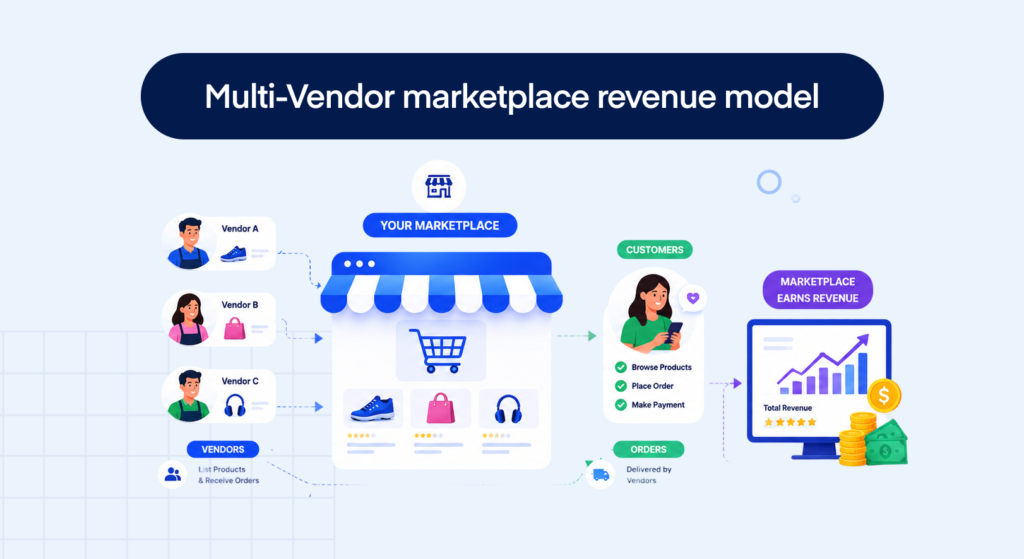
This is the question every new marketplace operator gets wrong. They focus on the platform before they figure out the business model. Here’s how successful marketplace operators actually generate revenue.
Commission model
The most common approach. You take a percentage of every sale — typically between 5% and 30% depending on the product category and your market positioning. Amazon takes 8–15%. Etsy takes 6.5%. Your rate depends on what you can justify with the value your platform delivers.
FlyCommerce lets you set different commission rates per vendor and per product category. High-margin categories can carry a higher rate. Low-margin, high-volume categories get a lower rate to attract quality vendors.
Vendor subscription model
Vendors pay a monthly or annual fee to list on your marketplace — regardless of how much they sell. This gives you predictable, recurring revenue from day one, before a single product is sold.
The most effective approach combines both: a base subscription fee plus a reduced commission rate. Vendors pay less per sale, you get reliable monthly income. FlyCommerce supports tiered subscription plans out of the box.
Listing and feature fees
Charge vendors for premium placement, featured product slots, or additional listing allowances beyond their plan. This is how Etsy and eBay generate additional revenue on top of commissions.
Most successful marketplaces use a combination of all three. You don’t have to commit to one model at launch — FlyCommerce lets you configure and adjust revenue rules as your marketplace matures.
| For the complete breakdown of every marketplace revenue model — with real commission rate benchmarks by industry — read: How Do Multi-Vendor Marketplaces Make Money? |
Is FlyCommerce the Right Platform to Build Your Marketplace?

FlyCommerce is the right choice if you want to launch a cloud-hosted marketplace or a single-vendor store that can grow into one, without managing servers, installing plugins, or writing a line of code.
It’s built for store owners, marketplace founders, and growing businesses that need vendor management, commission automation, global payments, and tax compliance from day one, starting at $1 per month.
For businesses that need more or want a fully custom solution, FlyCommerce’s Enterprise tier is built around your specific business needs.
| Ready to build your marketplace? FlyCommerce gives you everything covered in this guide – vendor onboarding, commission management, split payments, tax automation, and a drag-and-drop storefront in one cloud-hosted platform. |
Frequently Asked Questions
What is a multi-vendor marketplace?
A multi-vendor marketplace is an ecommerce platform where multiple independent sellers list and sell their products or services, while a single operator manages the platform, earns commission or subscription revenue, and controls the overall buyer experience — without holding inventory or fulfilling orders directly.
How is a multi-vendor marketplace different from a regular online store?
A regular online store has one seller. A multi-vendor marketplace has many independent sellers operating under one storefront, with the platform operator earning a percentage of each transaction rather than selling products directly.
How does a multi-vendor marketplace make money?
A multi-vendor marketplace makes money through commission on each sale, monthly vendor subscription fees, product listing fees, featured placement fees, or a combination of all four. Most successful platforms use a commission-plus-subscription model.
What is the difference between a marketplace operator and a marketplace vendor?
A marketplace operator owns and runs the platform. A marketplace vendor is an independent seller who lists products on the platform and pays the operator a commission or subscription fee in exchange for access to the buyer base.
How much does it cost to build a multi-vendor marketplace?
Building a multi-vendor marketplace costs from $15 per month on a SaaS platform like FlyCommerce, $500–$5,000 per year for a self-hosted WordPress setup, or $50,000–$250,000 for a fully custom-built solution.
What features does a multi-vendor marketplace platform need?
A multi-vendor marketplace needs vendor onboarding and approval workflows, a vendor dashboard for product and order management, flexible commission and payout management, split payment processing, tax automation, role-based access control, and a buyer-facing storefront.
Can one platform handle both a single-vendor store and a multi-vendor marketplace?
FlyCommerce handles both a single-vendor online store and a multi-vendor marketplace from one platform, allowing operators to start as a store and expand to a full marketplace without migrating to a different system.
What are examples of multi-vendor marketplaces?
Well-known multi-vendor marketplaces include Amazon, Etsy, eBay, and Airbnb. Niche examples include B2B wholesale platforms, rental marketplaces, digital product stores, and service booking platforms – all built on multi-vendor marketplace software.
Is FlyCommerce a multi-vendor marketplace platform?
FlyCommerce is a cloud-based SaaS multi-vendor marketplace platform built by weDevs — the team behind Dokan, which powers 40,000+ active marketplace deployments worldwide. FlyCommerce supports both single-vendor stores and full multi-vendor marketplaces from one subscription, starting at $15 per month.
Leave a Reply