

Not all online marketplaces are the same.
Amazon and Airbnb are both marketplaces. So are Fiverr and Alibaba. They look nothing alike, operate on completely different models, and require entirely different platforms to build.
That’s because ‘marketplace’ is a category, not a template. There are three different ways to classify a marketplace: by who transacts, by what is sold, and by how broad or narrow its focus is. Understanding all three frameworks is the first thing you need to do before choosing a platform, writing a business plan, or talking to a single potential seller.
I’ve worked alongside the team behind Dokan, the WordPress plugin powering 40,000+ active marketplaces across every one of these types. I’ve seen founders pick the wrong model for their goals and spend months rebuilding from scratch.
This guide covers every type, what makes each one different, and which model is right for the business you’re building.
TL;DR:
Online marketplaces are classified across three frameworks: who transacts (B2C, B2B, C2C), what is sold (products, services, rentals, digital goods), and scope (vertical niche vs horizontal broad). Most successful new marketplaces start vertical. FlyCommerce supports every type covered in this guide.
The 3 classification frameworks at a glance
| Framework | Types | Key examples |
| By who transacts | B2C, B2B, C2C | Amazon (B2C), Alibaba (B2B), eBay (C2C) |
| By what is sold | Product, service, rental, digital | Etsy, Fiverr, Airbnb, Envato |
| By scope | Vertical (niche) or horizontal (broad) | Reverb (vertical), Amazon (horizontal) |
Bottom line: Pick the wrong type and your entire platform architecture is wrong from day one. The three frameworks in this guide prevent that mistake.
Why the Type of Marketplace You Build Changes Everything
The platform decision comes after the type decision. Not before.
Every marketplace type has a different revenue model, a different payment infrastructure requirement, a different level of operational complexity, and a different path to achieving liquidity. Build a B2B marketplace on B2C software and you’ll have no way to handle bulk pricing, approval workflows, or net payment terms. Try to build horizontally without the supply chain infrastructure of Amazon and you’ll run out of cash before you achieve density in any single category.
Here are the three frameworks every marketplace founder needs to understand before they write a single line of code or sign up for a single platform.
1. By Who Transacts (B2C, B2B, and C2C)
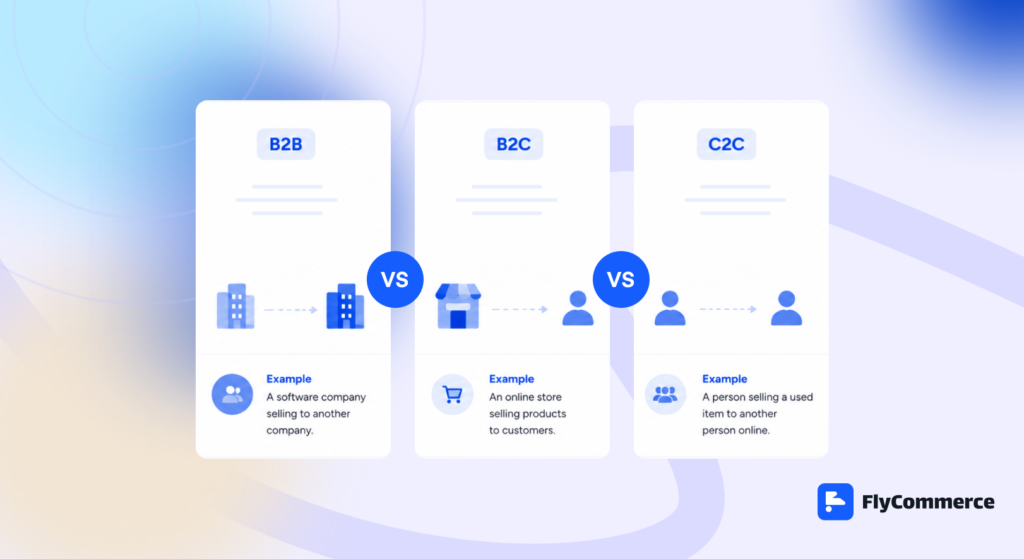
The most important classification. Who is on each side of your marketplace determines everything: how complex your payment infrastructure needs to be, how much trust you need to establish, what features your platform must have, and how much you can charge in commission.
B2C Marketplace (Business to Consumer)
A B2C marketplace is a platform where businesses and brands sell products or services directly to individual consumers, with the platform earning commission on each transaction.
This is the most familiar marketplace model. Amazon, Etsy, and Booking.com are all B2C marketplaces. Businesses are the sellers. Individuals are the buyers. Transactions are fast, standardised, and driven by price, selection, and trust signals like reviews and ratings.
B2C marketplaces prioritise: fast checkout with minimal friction, strong buyer trust mechanisms, wide product selection across multiple sellers, and consistent fulfillment standards.
For marketplace founders, B2C is the most common starting point. Commission typically runs 5 to 15% of each sale. The challenge is achieving liquidity, which means enough buyers and sellers to make the market feel active, before running out of runway.
- Real examples: Amazon (retail), Etsy (handmade and vintage), Booking.com (accommodation), Walmart Marketplace
- Commission range: 5 to 15% of transaction value
- Global market size: part of the $6.88 trillion B2C ecommerce market in 2026
B2B Marketplace (Business to Business)
A B2B marketplace is a platform where businesses sell products or services to other businesses, typically in bulk quantities with complex procurement workflows, approval processes, and contract-based pricing.
Here’s what most people don’t know about B2B marketplaces: they are enormous. The global B2B ecommerce market reached $36.16 trillion in 2026, growing at 14.5% annually. That is roughly five times larger than B2C ecommerce. The B2B market has grown 116% since the start of this decade.
B2B buyers are different from B2C consumers. They make larger purchases, involve multiple stakeholders in the decision, require custom pricing and bulk discounts, and often need net payment terms (pay in 30 or 60 days rather than immediately). Millennials and Gen Z now account for 71% of B2B buyers, and they are significantly more likely to purchase through marketplaces than previous generations.
B2B marketplaces require features that B2C platforms don’t need. If your platform can’t handle these, you cannot serve B2B buyers:
- RFQ (Request for Quote) workflows for custom pricing
- Bulk and tiered pricing structures
- Multi-stakeholder approval workflows before purchase
- Net payment terms and invoice-based billing
- Business account management with multiple users per organisation
- Exemption certificate management for tax-exempt B2B purchases
- Real examples: Alibaba (global wholesale), Amazon Business ($83.1 billion GMV in 2025), Faire (boutique retail wholesale), ThomasNet (industrial B2B)
- Commission range: 1 to 5% of transaction value (lower percentage, much larger transaction sizes)
C2C Marketplace (Consumer to Consumer)
A C2C marketplace is a platform where individual consumers buy and sell directly with other consumers, with the platform acting as the trusted facilitator rather than a seller or buyer itself.
C2C marketplaces enable ordinary people to monetise what they own. Used goods, secondhand fashion, peer-to-peer rentals, collectibles. The platform’s job is to provide trust infrastructure: identity verification, secure payments, dispute resolution, and ratings that let strangers transact safely.
The secondhand and resale economy is growing fast. The US resale and secondhand market reached $56 billion in 2025, driven by sustainability consciousness and a preference for value. Platforms like Vinted, Poshmark, and Depop have built billion-dollar businesses on this model.
The operational challenge in C2C: anyone can be a seller, which means quality control is entirely dependent on your rating and verification systems. Fraud and disputes happen more frequently than in B2C or B2B. Your trust infrastructure is your competitive moat.
- Real examples: eBay (general goods, auctions), Poshmark (fashion), Vinted (secondhand clothing), Depop (vintage and streetwear), Turo (peer-to-peer car rental)
- Commission range: 3 to 15% depending on category and transaction size
Here is how all three transaction models compare across the factors that matter most for platform builders:
| Factor | B2C Marketplace | B2B Marketplace | C2C Marketplace |
| Who buys | Individual consumers | Business buyers and teams | Individual consumers |
| Avg transaction size | $20 to $200 typical | $500 to $500,000+ | $10 to $500 typical |
| Transaction complexity | Low – single checkout | High – RFQ, approvals, net terms | Low – direct peer transfer |
| Trust mechanism | Platform ratings and reviews | Verified business credentials | Identity verification and peer reviews |
| Commission range | 5 to 15% | 1 to 5% | 3 to 15% |
| Market size 2026 | Part of $6.88T global ecommerce | $36.16T – 5x larger than B2C | $56B US resale market alone |
| Real examples | Amazon, Etsy, Booking.com | Alibaba, Amazon Business, Faire | eBay, Poshmark, Vinted, Depop |
B2B vs B2C Marketplace: The Key Differences
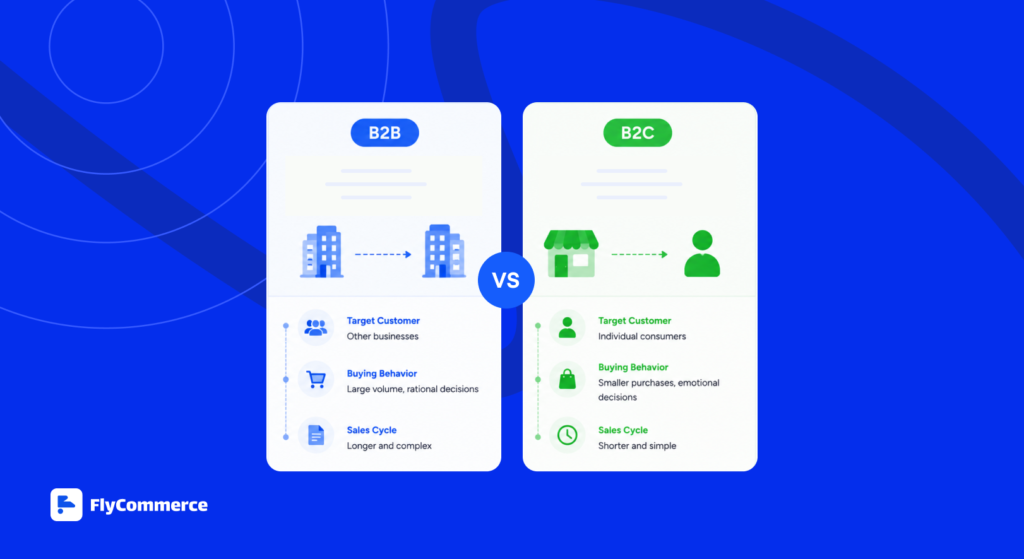
B2B and B2C marketplaces share the same basic structure: a platform connecting sellers with buyers, earning commission on transactions. Everything else is different.
B2C buyers make decisions fast. They compare prices, read reviews, and complete checkout in minutes. B2B buyers involve an average of 6 to 13 stakeholders in a single purchase decision depending on deal size. They run procurement workflows, require custom pricing agreements, and often need to pay on invoice terms rather than immediately.
Here’s what this means in practice for platform builders:
| Feature requirement | B2C marketplace | B2B marketplace |
| Checkout flow | Single-step, card payment, instant | Multi-step, PO numbers, net 30/60 terms |
| Pricing | Fixed price per product | Custom quotes, bulk discounts, contract pricing |
| Account structure | Individual buyer accounts | Organisation accounts with multiple users and approval tiers |
| Payment timing | Immediate at checkout | Invoice-based, delayed payment on terms |
| Tax handling | Standard sales tax calculation | B2B exemption certificates, cross-border VAT, complex compliance |
| Order minimum | No minimum required | Minimum order quantities (MOQ) standard |
| Reordering | Occasional, browsing-driven | Frequent, repeat procurement cycles |
The platform implications are significant. A B2C platform built on FlyCommerce’s standard configuration works out of the box. A B2B marketplace requires the Enterprise tier, which includes the account management, approval workflows, and tax compliance features that B2B buyers expect.
| For the full breakdown of how marketplace revenue models work across B2C and B2B, read: How Do Multi-Vendor Marketplaces Make Money? |
2. By What Is Sold
The second framework: what is actually being exchanged on your marketplace. This determines your inventory model, your fulfillment complexity, your trust requirements, and the technical infrastructure you need.
Product Marketplace
A product marketplace is a platform where multiple sellers list physical or digital goods for buyers to purchase outright.
The most common marketplace type. Amazon, Etsy, and eBay are all product marketplaces. Physical products require the full logistics stack: inventory management, shipping integrations, returns processing, and sometimes warehousing.
Digital product marketplaces are a subset worth calling out separately. No inventory. No shipping. Sellers upload files and buyers download them. Margin is high and complexity is low, but IP protection policies matter enormously. If your platform allows counterfeit digital goods to proliferate, you lose seller trust fast.
- Physical product examples: Amazon, Etsy, Walmart Marketplace, Wayfair
- Digital product examples: Envato (templates and assets), Gumroad alternatives, course and ebook platforms
- Builder note: the inventory model (who holds stock) is the most important architectural decision. Vendor-managed inventory is standard for multi-vendor marketplaces. Consignment or platform-managed inventory adds operational complexity.
Service Marketplace
A service marketplace is a platform where buyers connect with service providers for time-based or project-based work, with the platform facilitating discovery, payment, and communication.
Services cannot be inspected before purchase. This makes trust infrastructure the single most important technical investment in a service marketplace. Ratings, verified reviews, identity verification, portfolio showcases, and dispute resolution all matter more here than in product marketplaces.
The scheduling and availability problem is also unique to services. You need calendar integrations, real-time availability management, and booking confirmations. Payment timing differs too: most service marketplaces hold payment in escrow and release it only on completion, which requires a more sophisticated payment integration than a standard product checkout.
- Examples: Fiverr (freelance digital services), Upwork (professional services), TaskRabbit (local services), Thumbtack (home services).
- Builder note: service marketplaces need robust dispute resolution from day one. The most common failure mode is a buyer and seller disagreeing on whether the work was completed satisfactorily. Build your resolution policy before your first transaction.
Rental and Booking Marketplace
A rental marketplace is a platform where asset owners list their property for temporary use, and renters pay for access rather than ownership, with the platform managing availability, payments, and liability.
Rental marketplaces sit at the intersection of product and service. You’re not buying the asset. You’re buying temporary access to it. Airbnb, Turo, and Fat Llama are all rental marketplaces, covering properties, vehicles, and equipment respectively.
Two technical problems that are unique to rental marketplaces: availability management and damage liability. You need a real-time availability calendar that prevents double bookings. You need a clear policy on who is responsible when something is damaged, and ideally an insurance integration or damage deposit mechanism. These are not optional features. They are the core trust infrastructure that makes the model work.
- Examples: Airbnb (short-term accommodation), Turo (peer-to-peer car rental), Fat Llama (equipment rental), Swimply (pool and venue rental).
- Builder note: start with one asset category in one geography before expanding. Rental marketplaces are highly local in their early stages.
Digital Products Marketplace
A digital products marketplace is a platform where creators sell downloadable or licensed digital goods including templates, software, courses, stock assets, and design files.
Digital products marketplaces have the most favourable unit economics of any type. No inventory. No shipping. No returns. A seller uploads a file once and earns from it indefinitely. Commission is typically 20 to 50% because the platform provides the entire distribution infrastructure.
The build complexity is relatively low compared to physical product or service marketplaces. The hardest problem is IP enforcement: ensuring that the digital goods on your platform are genuinely owned by the sellers listing them, and preventing unauthorised redistribution after purchase.
- Examples: Envato Market (templates and themes), Creative Market (design assets), Gumroad alternatives, Teachable-style course marketplaces
- Builder note: digital products marketplaces can be launched on FlyCommerce without custom development. The zero-inventory, zero-fulfillment model is the fastest path from signup to first transaction.
Quick comparison across all four types:
| Type | What is sold | Real examples | Inventory needed | Complexity |
| Product marketplace | Physical or digital goods | Amazon, Etsy, eBay | Vendor-managed | Medium |
| Service marketplace | Time or expertise | Fiverr, Upwork, TaskRabbit | None | High |
| Rental marketplace | Temporary asset access | Airbnb, Turo, Fat Llama | Owner-managed | High |
| Digital products | Downloadable goods | Envato, Creative Market | None | Low |
3. Vertical vs Horizontal Marketplace
The third framework is the most important strategic decision for new marketplace founders. It is also the one most people get wrong.
Vertical Marketplace (Niche)
A vertical marketplace focuses on a single industry, product category, or customer segment, offering deep selection and specialist expertise within one defined niche.
Reverb owns used musical instruments. Faire owns boutique retail wholesale. StockX owns authenticated sneakers and streetwear. Vroom owns used cars. Every one of these platforms built a dominant position by going deep in one category before expanding.
Vertical marketplaces win for four reasons. First: easier seller acquisition. You know exactly which sellers to recruit and where to find them. Second: faster liquidity. It’s easier to achieve the critical mass of supply and demand in one niche than across many categories simultaneously. Third: stronger buyer trust. A specialist marketplace signals expertise. A marketplace that sells everything signals nothing. Fourth: defensible moat. Once you own a niche, a generalist competitor can’t easily dislodge you without investing massively in category-specific expertise.
- Examples: Reverb (musical instruments), Faire (boutique wholesale), StockX (sneakers), Vroom (used cars), Houzz (home design), DogVacay (pet sitting).
- Builder advantage: one focused niche, one seller community, one buyer audience. Achievable with limited resources.
Horizontal Marketplace (Broad)
A horizontal marketplace sells across multiple product categories and industries, aiming to be a one-stop destination for a wide variety of buyer needs.
Amazon, eBay, and Walmart Marketplace are horizontal. They work because they were built with enormous infrastructure investment, established trust over years, and achieved the scale needed to make broad selection valuable to buyers.
Here’s the reality for new marketplace founders: you cannot out-Amazon Amazon. You cannot out-eBay eBay. These platforms have logistics networks, buyer trust signals, and seller tools built over decades. A new horizontal marketplace attempting to compete on breadth starts with no sellers, no buyers, and no trust in any category simultaneously.
Why horizontal marketplaces fail at launch?
I’ve watched founders choose horizontal and run out of runway before achieving liquidity in any single category. The classic failure is launching with 200 sellers across 15 categories and ending up with 13 listings per category on average. No buyer comes back to a marketplace with 13 products in their category. You need density to create value. Density only comes from focus.
| Factor | Vertical Marketplace | Horizontal Marketplace |
| Focus | One industry or category | Multiple categories and markets |
| Amazon competition | Avoids it entirely | Competes head-on with Amazon and eBay |
| Seller acquisition | Easy – targeted outreach to specific niche | Hard – need sellers across many categories simultaneously |
| Buyer trust | High – platform is a specialist | Requires years of trust-building across all categories |
| Time to liquidity | Faster – density in one niche first | Slow – need volume across all categories at once |
| Resources required | Manageable for a small team | Requires significant capital and infrastructure |
| Real examples | Reverb, Faire, StockX, Vroom | Amazon, eBay, Walmart Marketplace |
| Recommended for | New founders – always start here | Established platforms with existing supply and demand |
The recommendation for new marketplace founders is unambiguous: start vertical. Own one niche completely. Build density of supply and demand. Earn trust with a specific community. Then expand from a position of proven strength, not blind ambition.
How to Choose the Right Marketplace Type for Your Business
You’ve now seen all three classification frameworks. Here’s how to apply them to your specific situation.
For the B2C vs B2B vs C2C decision:
- Choose B2C if your sellers are businesses or brands and your buyers are individual consumers. Most consumer-facing marketplaces are B2C.
- Choose B2B if your sellers are suppliers or manufacturers and your buyers are other businesses. If your transactions involve bulk orders, custom pricing, or procurement teams, you are building B2B.
- Choose C2C if you’re enabling individual people to sell to other individual people. Resale, peer rental, and secondhand goods are almost always C2C.
For the product type decision:
- Build a product marketplace if you’re connecting buyers with physical or digital goods. The most straightforward type to launch.
- Build a service marketplace if you’re connecting buyers with providers of time-based or project-based work. Invest heavily in trust and verification infrastructure from day one.
- Build a rental marketplace if you’re enabling temporary access to assets. Prioritise availability management and damage liability policies before launch.
- Build a digital products marketplace if your sellers are creators selling downloadable goods. Lowest complexity, highest margin type.
For the vertical vs horizontal decision: start vertical. No exceptions for new founders. Pick the single most underserved niche in your chosen category. Own it before you expand.
Ready to Build? How to Launch Your Marketplace with FlyCommerce
You now know what type of marketplace you’re building. Here is how to go from that decision to a live platform.
The four steps, briefly: validate your niche with 10 real sellers and 10 real buyers who say yes before you build anything. Confirm your marketplace type using the three frameworks above. Choose a platform that natively supports your type. Launch with a focused seller cohort before opening to the public.
FlyCommerce supports every marketplace type covered in this guide. B2C, B2B, and C2C transaction models. Product, service, rental, and digital product marketplaces. Vertical and horizontal scope. The Enterprise tier adds the B2B-specific features required for bulk pricing, approval workflows, and business account management. All plans start with a 14-day free trial.
| For the complete step-by-step process, including platform comparison, vendor onboarding, payment setup, and cold start tactics, read the full build guide: How to Build a Multi-Vendor Marketplace. |
Build your marketplace. Any type. One platform. FlyCommerce supports every marketplace model in this guide. Start with a 14-day free trial.
Frequently Asked Questions About Types of Online Marketplaces
What are the main types of online marketplaces?
Online marketplaces are classified across three frameworks: by who transacts (B2C, B2B, C2C), by what is sold (products, services, rentals, digital goods), and by scope (vertical niche or horizontal broad). Most marketplaces can be categorised across all three frameworks simultaneously.
What is a B2C marketplace?
A B2C marketplace is a platform where businesses sell products or services directly to individual consumers, with the platform earning commission on each transaction. Amazon, Etsy, and Booking.com are B2C marketplaces.
What is a B2B marketplace?
A B2B marketplace is a platform where businesses buy and sell products or services to other businesses, typically in bulk with complex procurement workflows. The global B2B ecommerce market reached $36.16 trillion in 2026, making it roughly five times larger than B2C ecommerce.
What is a C2C marketplace?
A C2C marketplace is a platform where individual consumers buy and sell directly with other consumers, with the platform acting as the facilitator. eBay, Poshmark, and Vinted are C2C marketplaces. The US secondhand market reached $56 billion in 2025.
What is the difference between a vertical and horizontal marketplace?
A vertical marketplace focuses on one specific industry or category. A horizontal marketplace sells across multiple categories. New marketplace founders should almost always start vertical because achieving buyer and seller density in one niche is far easier than across many categories simultaneously.
What is a product marketplace?
A product marketplace is a platform where multiple sellers list physical or digital goods for buyers to purchase outright. It is the most common marketplace type. Amazon sells physical goods. Envato sells digital design assets. Both are product marketplaces.
Is Amazon a B2C or B2B marketplace?
Amazon operates as both. Amazon’s consumer retail platform is a B2C marketplace. Amazon Business is a separate B2B marketplace that reached $83.1 billion in GMV in 2025. The same parent company runs both models with different platform features for each.
Does FlyCommerce support all marketplace types?
FlyCommerce supports B2C, B2B, and C2C transaction models, product and digital product sales, and both vertical and horizontal scopes. The Enterprise tier adds B2B-specific features including bulk pricing, approval workflows, and business account management. All plans include a 14-day free trial.
Leave a Reply